Sunday, January 13, 2019

Clean Water & Sanitation

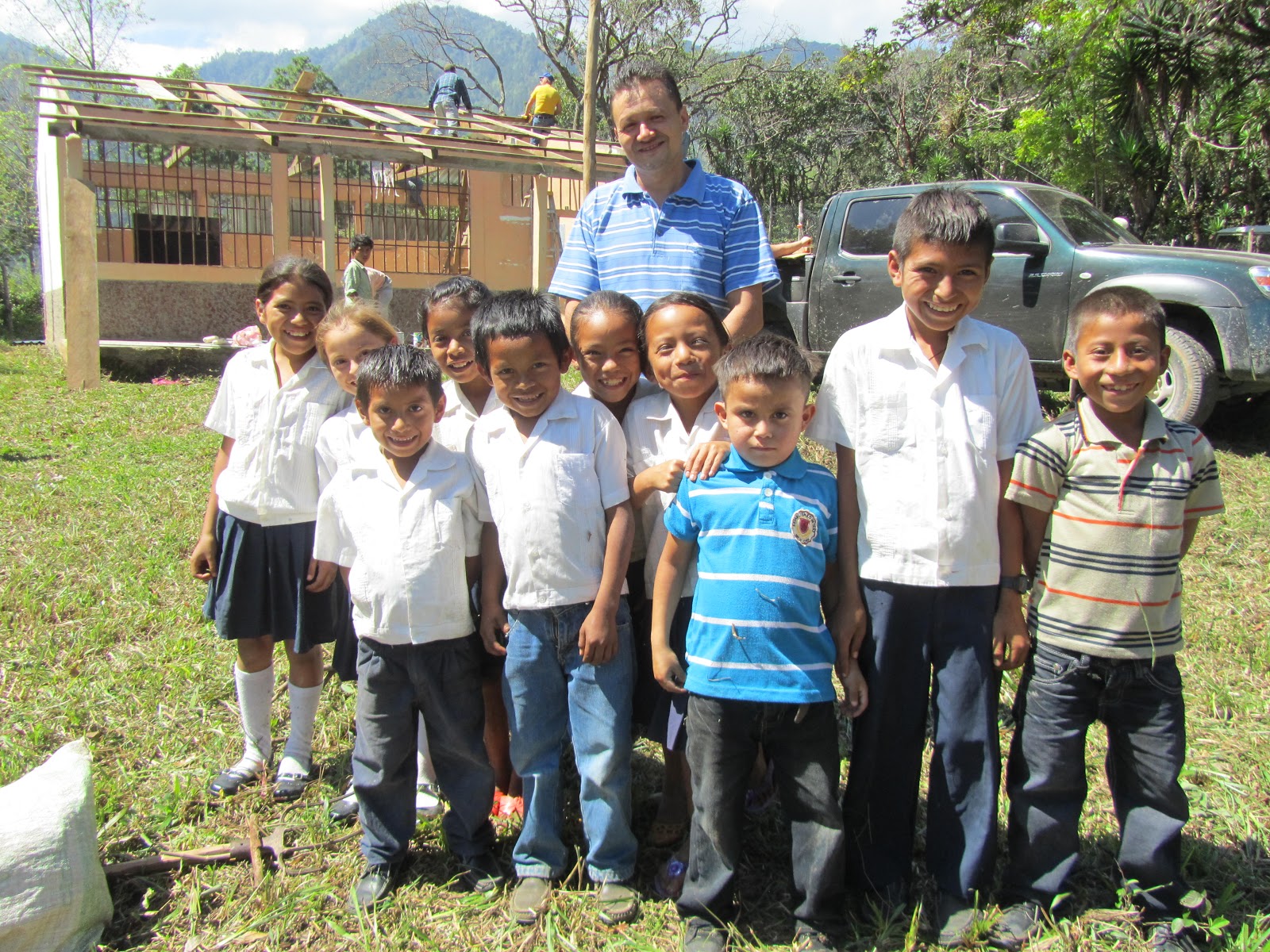
We raised the money to start a pilot project at twelve schools near the City of Santa Barbara in the western mountains of Honduras. The Rotary Club in Santa Barbara, Honduras is leading this effort in collaboration with residents of each of the villages or barios where the schools are. The Rotary Club has four teams of it members, each working with parents, teachers, and community members at each of three communities where schools are.
Community member at Tacahulapa School explains that, when it rains, the septic holding tank overflows into the schoolyard. Right now, the students do not use the current toilets.

The initial funding for the projects was raised with Rotary leadership from the communities of Creston, British Columbia, Canada and the U.S. communities of Bemidji, MN; Park Rapids, MN; Wahpaton, SD; and Ashland, WI. Rotary clubs in districts on the U.S.-Canada border matched 100% of the funds each community raised, and the international Rotary Foundation matched 150% of the communities' funds. When one considers the breadth of effort, it is clear why the Rotary Foundation calls these "Global Grant" projects. They happen only when people of many nationalities, faiths, and cultures collaborate in a shared mission.
Community members in Gualjoco dig trench for the new foundation.

The family sow next door to the El Trabajo school in Inguaya escapes to the schoolyard to join the meeting of parents, teacher, and Rotarians.
Santa Barbara Rotarian Rene Vasquez explains how bathrooms will be added adjacent to existing classrooms at Inguaya.


Sunday, January 28, 2018

Zorca!

"Before we start our conversation, let's first work together in commitment."

Roxanna Turner taught me the value of this statement today. Some members of previous teams have said we should provide funds for Honduran communities to maintain their own schools rather than bringing the supplies and doing the maintenance work with them. When I mentioned this to Roxanna as we arrived, she disagreed.

Roxanna Turner is a teacher at the high school in the Ashland, Wisconsin school district. She previously worked on a grant that the Ashland Rotary Club initiated through the Duluth-Superior Community Foundation to adapt the foundation's Speak Your Peace curriculum for high school students, and the project received the foundation's Touchstone Award as an outstanding example of achievement. Rene, a Santa Barbara, Honduras Rotary Club member, brought Roxanna and me, along with painting supplies, to Zorca while the others in our group purchased additional supplies for our day's work. When we arrived, a beautiful rainbow appeared in the sky above us.
View behind the Zorca school.

Zorca (14.85183°N, 88.35183°W) is a small village in the mountains west of the small city of Arada. As Rene parked his truck on the side of the road, two women wearing pink pull-overs waved to us from the school atop a stairway to the road. Then a man and a boy came down to help us carrry the six-gallon buckets of paint, our ladder, and painting supplies up to the school. When we climbed the stairway, we saw several more men and women in the the two classrooms moving the desks, shelves, and tables to the center and scraping the walls to prepare them to be painted. A new kindergarten building had just been constructed next to the elementary school, and more parents were sweeping to prepare the concrete walls for their first coats of paint. We learned that everyone in the community was eagerly getting the schools ready for the beginning of the school year next week.

As we carried buckets and boxes up the stairs, I told Roxanna what some previous participants on these Rotary mission trips said about providing funds to these communities for maintenance rather than traveling to Honduras to help them do maintenance work.

"Not necessarily," she replied. "It is very important for me as a teacher to make my classroom an attractive space for learning. The work being done here takes that effort to a whole new level."  Along with the parents and teachers, we picked up brushes, rollers, and trays filled with fresh paint and went to work.

As I painted trim around the windows on the front of the school, I overheard Roxanna talking with school boys around the corner as she worked a roller on a long pole. I do not speak Spanish, but their questions and answers of each other were interspersed with laughter as a shy, young father quietly worked alongside.
Teachers paint the window grates (from left: Roxanna Turner,
Erlin Izaguirre, and Yara Enamorado).

As the day progressed, I came to realize that this project provided a means for Roxanna and that father to build an understanding of each other without the tension of an interview process. The school kids' natural curiousity provided a means for learning about each other as the basic need to prepare the school for the new year was served. By the end of the day, we not only completed an important project in the little, mountain village of Zorca, but we also learned about each other and made new friends.

Tuesday, January 17, 2017

Being Called?

There is an interesting story in the Old Testament Book of Samuel where Samuel, a boy helping an elderly priest, is awakened at night by a voice calling his name. Because the only other person around is the man down the hall, Samuel runs to see what the old priest wants. The old man is irritated because he did not call the boy and tells the boy to go back to bed. When the situation repeats two more times, the priest realizes that Samuel IS being called, not for work but for LIFE, and Samuel's life changes forever. The lesson I take from this story is that our true calling often is not obvious to us.

I thought of this story on Saturday night when we attended the Santa Barbara Rotaract Club meeting. Allison Radke, a youth minister who is part of our group and who is fluent in Spanish, served as interpretor. Rotaract members are people ranging from college age to less than thirty years old. This club inlcudes college students, an auto mechanic, attorneys, teachers, government administrators and others. As the meeting was about to start, Allison said in English "I just had an idea." Then she asked a question in Spanish that she told us was "How many people here use Whatsapp?" Almost all the Rotaractors raised their hands. After a brief explanation, the club members said that they would help us to effect our hope to establish internet communications between elementary kids in Las Brisas del Pinal and kids in the Chequamegon Bay area. When Allison explained the frustration that the teachers in Las Brisas had trying to project a Facebook video through their LCD projector, the Rotaractors pulled out their LCD projector and said "Here's how you do this . . .We will help." They responded immediately to our call for help. When my wife Becky quietly asked me, "who in the Ashland area is going to work with this vibrant group of young professionals," I replied, "They have not yet been called."

Earlier on Saturday morning, I wondered if I was hearing "a call" or just another solicitation when the leaders of the Santa Barbara Rotary Club met with our small group. They explained that the international Rotary Foundation and UNICEF (the United Nations International Child and Education Fund) had selected Honduras as one of five countries in the world for a pilot project promoting clean water and sanitary practices to reduce widespread diarrheal illness in children and communities and to help girls to stay in school past sixth grade. The local Rotarians asked if we would be the international sponsors for their projecct for the Department of Santa Barbara (about the area of Ashland and Bayfield counties in Wisconsin). The minimum contribution for us to be a sponsor is $30,000, including a matching contribution from the Rotary Foundation. In any case, we would need to raise at least $10,000 in order to be a WASH-in-Schools sponsor.

It seems like a risky proposition. The Santa Barbara Rotarians said that the project for Honduras is organized by their Rotary District to include all the Rotary Clubs in Honduras. The pilot project for the Department of Santa Barbara involves selecting at least five schools, and requires installing any necessary infrastructire, curriulum adoption, teacher training, and implementation within one year. The project requires before and after testing for measureable improvements and documentation that the pilot projects will continue after the international funding runs out.

Steve Rith-Najarian is a physician on our LARA team who is a national leader in helping Native Americans reduce the incidence of diabetes-related illness on reservations. He said there is no doubt about the serious need to improve access to clean water and to adopt better sanitation in schools and communities, but to expect a measurable change by the end of 2018 is unrealistic. I agreed that the project expectations are unrealistic, but it is appropriate to start small in these ambitious initiatives so that future projects can improve on the lessons learned from the preliminary projects. After all, there are many more than five countries plagued by contaminated water supplies and diarrheal illness.

Allison Radke facilitated a conversation about the project with the kindergarten teachers in Las Brisas del Pinal. This barrio on the outskirts of Santa Barbara has experienced rapid growth as families from small mountain villages come to the city in hopes of finding employment. These teachers know how little most children and their families understand the need for sanitary practices. They told us that there is no question about the huge scope of the problem, but added "You have to start somewhere, and Honduras is a good place to start." They said that the parents association in Las Brisas has become well aware of the problem, and they make sure that the bathrooms at the kindergarten are well supplied with soap and toilet paper. Even so, water runs into the community water supply only two days per week, and they have to ration use so that their stored supply does not run out.

Is a request of this scope just another of many solicitations for a hopeless cause, or is this our calling to take small, deliberate steps to improve children's and communities' access to clean water and adequate sanitation? Is it just coincidence that we are faced with a decision on Martin Luther King, Jr. Day? Can our small steps lead to a change of the scope of Rotary's commitment decades ago to eliminate polio from the world? Some of our group tired of the long discussion we had after dinner to determine whether we can commit to be a sponsor. One member said, "I just want to do the work. I can't deal with writing proposals or deciding who is responsible for documenting how every penny is spent. There is a great need. Let's not hesitate to do something about it." Even so, he recognized that someone needs to design projects, write proposals, and track progress. He said, "I want to help, but not with the bureaucracy.

In the end, we decided that we will raise $35,000, which we hope we can achieve by raising $10,000 from clubs and our communities and multiply with matching contributions from our Rotary District and the Rotary Foundation. Even if we cannot get matching contributions, $35,000 may not be enough for five separate, pilot projects. All of our clubs in the northern USA take pride in our abundant, clean water. People in the poor communities in Honduras did not consciously decide to contaminate their water supplies any more than the people of Ashland and Barksdale chose to contaminate theirs. Finding sustainable solutions to provide clean water "has to start somewhere."

Saturday, January 14, 2017

Seeking Sustainable Projects

Our work in Honduras was reduced by a day because our flight from Duluth to Chicago was cancelled when a wet snow and fog prevented landings. Instead, we drove an icy highway to Minneapolis and flew directly from there to Houston. When we arrived in Santa Barbara, the local Rotarians were eager to put us to work on the project in Aridita that we planned last year: installing a roof on an expanded multipurpose building in the mountain community of Aridita (14.98037°, -88.30410°) northwest of Santa Barbara in the municipality (like counties in the USA) of Nuevo Celiac. Members of the community and the parents' assocation already had installed new cconcrete block walls and new metal beams when we arrived to assist in putting on new sheets of metal on the roof.

There always are interesting "synchronicities" on mission trips. The same day we arrived in San Pedro Sula, two missionaries supported by the United Church of Christ's One Great Hour of Sharing also were returning from a trip to Panama and Columbia. Don and Maryjane Westra are natives of Fergus Falls, MN who have been working to make a vocational school program more sustainable in Yoro, Honduras. In rural Honduras, fifty perent of the population lives in extreme poverty. Access to education beyond the elementary grades is very limited, and, therefore, most people lack the skills required for good-paying jobs. Last year one of the Santa Barbara Rotarians asked our group to assist with improving a vocational school in Santa Barbara, and the Westra's have the knowledge and experience to help us understand what approaches might be successful.

Another Santa Barbara Rotarian met with us during our first evening in the city and asked our group to be a partner in attracting funding from the Rotary Foundation to implement a multi-faceted program to improve rural sanitation and to reduce water-borne disease by enhancing sanitary facilities and practices in area schools. We also came this year with the intention to develop a program of enhanced communications between children in the community of Las Brisas del Pinal (14.94582°, -88.23488°) and children in the Chequamegon Bay area. When we attended the Santa Barbara Rotary Club meeting on Friday evening, a young woman, who is president of the Santa Barbara Rotaract club (young professionals engaged in community service), said that their club would like to collaborate with us in developing this project.

There is no shortage of important projects where help is needed. One person who is a great help in all these endeavors this year is Allison Radke, the youth minister at the United Presbyterian-Congregational Church in Ashland. Allison's fluency in Spanish and good humor have made her a hit with every group we encounter and a real benefit in our communications.

Sunday, March 6, 2016

Building Bridges Through The Internet

One of Rotary's four main objectives is "the advancement of international understanding, goodwill, and peace through a world fellowship of business and professional people united in the ideal of service." This goal underlies more than twenty years of collaboration between the north country Rotary clubs and the Santa Barbara Rotary Club. The perspective of Rotarians from the north is that the professionals in the Santa Barbara Rotary Club are much more capable than we to identify critical needs in their home territory. Our tasks in the north are to help people in our area to develop a compassionate understanding of our connections to Honduras and to determine which of the critical needs we are best able to serve.

The Internet and digital technology are effecting dramatic changes in the ways we collaborate. Traditionally, communications between Santa Barbara and the north needed to occur face-to-face. Even then, we could understand a need only by sending an advance team of northerners along with local Rotarians to a place to prepare a plan of action. Now people in remote villages have cell phones with cameras and email -- even when there is not electrical utility service in the village. Before the north country Rotarians arrive, it is possible to have satellite images of a project site and instant photos of the inside of buildings and the conditions of the local population. Even better, communications no longer need to be limited to the annual mission trip.

I know only a few words of Spanish. This year I could send an email from Honduras to my wife Becky in Wisconsin (who is fluent in Spanish) and ask her to let the teachers in a village down the road know that i will bring them some instructional equipment at 8:30 A.M. the next day. The teachers sent Becky photos of the donation event before I returned to my hotel. There is nothing better than face-to-face communication, but today's technology allows us to stay in touch year-round.

Before Steve and i came to Santa Barbara, Becky sent an email to the teachers in that village (Colonia Las Brisas del Pinal; N14.94619, W088.23431), where we built a two-room kindergarten two years ago. A number of people from the United Presbyterian-Congregational Church in Ashland, Wisconsin assisted Rotary in building that kindergarten. Becky has stayed in touch with those teachers ever since, especially with Lily May Oliver-Urbina. Becky asked Lily May if her students needed notebooks, pencils, and crayons that our church had collected for me to take to Honduras. Lily May replied that the school really needed a digital projector so that whole classrooms of students could see a computer screen.

Our church provided me with a projector to give to the school. Our hope is that communications among the people in our communities no longer need be limited to annual trips. Kids in Honduras can watch kids up north sail-skiing on an ice-covered lake, and kids in Ashland can watch barefoot kids in Honduras adeptly passing soccer balls in the shadow of verdant mountain peaks.

When I was in elementary school, my teachers arranged for me to write "pen pals" at far-away schools. That entire process has been replaced by Facebook pages and instant messages. It is even more important in this age of instant messages that people have a more sensitive understanding of other people's cultures. We hope that, by sharing this technology, we can build digital bridges between our communities to enhance international understanding united in the ideal of service.

Saturday, March 5, 2016

Serving Needs, Assessing Needs

On Friday we went to another small village in the mountains: El Guineal (N15.15172, W088.28310) in the municipalidad of Trinidad (like an unincorporated village in a rural town in Wisconsin). As we did on Thursday, we helped the villagers to replace a leaky roof on their school with a new one, and we painted the concrete block structure inside and out. In this season of Lent, there is a certain value in simply picking up a broom or a paintbrush and working alongside a new acquaintance on a community project. This practice reflects Rotary's Motto "Service Above Self." Even though neither of us speaks a common language, we each share a common sense that we are doing something that, in a small way, will enhance the educational experience of a child.

Does a classroom that is a little brighter and no longer has paint peeling from the concrete block walls make a math lesson more engaging? The teacher standing in front of 45 students in this tiny mountain village tells us that the quality of the classroom affects the quality of learning. So we quietly scrape, sweep, and paint side-by-sde. Neither of us is earning a wage today. We smile at each other and hope that we will help in a small way to enhance opportunties for another generation. Our sweat mixes with the paint in this remote village where families grow and pick cofffee for their livelihoods. The discipline of quietly serving a need without asking questions calms my soul.
The view from El Guineal.

But as I track my progress to check whether today's project will be complete when it is time to pack up the tools and head back to Santa Barbara, I start to ask questions. Why am I painting a little schoolhouse on a Honduran mountainside? There is a part of me that wants to know about my daily cup of coffee. If I drink coffee, shouldn't I know something about what goes into getting it to my cup? I take pleasure in knowing the Tetzner family and their farm from which I buy my milk. It seems appropriate that I should learn about the people who provide me with coffee beans. Do these coffee farmers have a similar sense about the people who consume their produce as the Tetzners do about me? It is clear that there are far fewer community resources available for the education of the coffee farmers' children than there are for the Tetzner kids. Is that fair? How much of the market price of coffee goes back to the coffee farmers who produce it?
The mayor of Nuevo Celilac and the community
of La Aradita show us their old center.

When we returned to Santa Barbara at the end of the day, several people made a point of crossing paths with Steve and me. It is good that Steve speaks some Spanish because I would have no idea what to say, even if they succeeded in getting me to understand what they were asking us. Two teachers from one of the Santa Barbara technical schools asked us to take a tour of their facility. It, too, has leaky roofs and inadequate instructional equipment. Then a teacher from the nearby city of Ilama (N15.05882, W088.23267) told us that there are not enough desks for all the students at her school. Then the owner of a coffee farm told us that the community near his farm needs a kindergarten. He said that his family would like to cost-share with us in building a structure. On Friday evening, we joined the meeting of the Santa Barbara Rotarians. They asked us to go to the village of La Aradita (N14.98037, W088.30410) on Saturday morning and meet with the Mayor of the municipalidad of Neuvo Celilac and the village people to discuss what it would take to rebuild their one-room community center, which currently has a ceramic tile roof that leaks badly and which they say is now too small for their needs.

How should we Rotarians and community members in the north country respond to all these needs? We hear some political leaders say "build a bigger wall on the border and send all these needy people away. Their needs should not be our worry." The fact is that the militarization of the US/Mexico border actually has INCREASED the number of undocumented workers in the US since the late 1980's. US tax dollars now fund a $74 billion private prison industry that employs 800,000 people and locks up migrants, most of who are not violent criminals. The US Border Patrol employs an additional 21,000 workers, and 63,000 undoumented people are imprisoned while awaiting trial. Each person held in detention costs US taxpayers $55,000 per year. It appears to be in the USA's own interest to consider the needs of the people who live south of the border. What needs of the people who grow and pick my coffee, bananas, and palms and who sew my clothes might be served in a way that enhances their lives in their own country?

All the requests that the Santa Barbara people laid before us are legitimate needs, but the needs are greater than the limited resources that the Latin America Rotary Aid (LARA) program has. At the end of the afternoon, LARA held its annual meeting at our hotel. The participants agreed that we need to set priorities. Somehow, we should look for synergies among projects, and we should explore if there are matching grants that might expand the amount of resources available for a project. That will be part of our homework as we plan next year's service. One LARA member asked if we could enhance the welding program and the wood shop program at the technical college and provide funds for the students to make desks for the students at Ilama. Another asked if we could obtain matching grants through the Rotary Foundation's Vocational Training Team program. The Rotary Foundation will not provide funds to repair leaky roofs, however. We have lots of questions to answer before we can assure donors that their funds will best serve the needs this area faces.

Friday, March 4, 2016

A Very Long Day - Monte Cristo

We worked in a remote mountain village -- Monte Cristo (N 15.12654, W088.301259). We travelled for about 10k on a winding, narrow dirt road up and down hillsides. The community people were already at work when we arrived. The old roof was off, and men were welding metal braces to the angle-iron rafters. 45 school kids were crammed into a tiny school room. We passed out school supplies and then started to work. I'll give more details later.

When we returned to Santa Barbara, two men were waiting to ask Steve and me to go on a tour of one of the public high schools "collegio technico" in Santa Barbara. It was late when we returned, and I fell into bed. I will have to download photos and write more details after the work in El Guineal today and the Santa Barbara Rotary meeting tonight.

Thursday, March 3, 2016

Returning After Missing 2015

The Latin America Rotary Aid (LARA) board of directors suspended its 2015 Honduras mission trip when we received word of gang violence in Santa Barbara late in 2014. A gang kidnapped a passenger from a taxi cab. There was a shoot-out with a rival gang. The driver was injured and taken to the hospital. The rival gang broke into the hospital and dragged the driver out and killed him. One of the shooting victims was a half-brother of one of our LARA Rotarians, and the incident left her feeling less secure about traveling on remote roads. He had always assured her that, when our team traveled on back roads, he had friends who would watch to assure that we were safe. Even when local Rotarians acccompanied us, she felt more secure because of her half-brother's promise.

Yesterday I returned with LARA direcctor Steve Rith-Najarian and will meet Mel and Lourdes Tangen tomorrow to start one of two school projects. On this trip we are assessing security and determining what risk management measures we should follow for future trips.

When we arrived in Santa Barbara yesterday. Rene Vazquez, a local Rotarian, met us at our hotel. He asked why we have such a small group this year. We explained that we were concerned about bringing a larger group until we understand what risks there are to traveling to remote villages. Rene was surprised. He said that conditions in this area are little different from those during our past trips. He said that we need to be concerned about conditions in the large city of San Pedro Sula, but we can continue to be active in the Santa Barbara area. As in the past, we will always have a local Rotarian with us when we travel to the remote villages.
Some of my clothes made in Honduras.

It seems as important as ever to maintain our connections with Hondurans. American companies continue to rely on Honduran labor for manufacturing and for agricultural produce. US citizens should be aware of the conditions in the places where we do business. When I packed for this trip, I quickly saw how many of my clothes were made here.

Tuesday, February 25, 2014

A Family United

This year’s LARA activities included a special dimension.  One of the members of our group is a twenty-one year old man Yester Voss from Hamilton, Ohio.  Yester was born in Honduras near Santa Barbara with a severe cleft lip and cleft palate.  When he was a baby, Yester’s condition could readily be repaired in the United States, but his family could not afford to get the required series of surgeries.  Nineteen years ago, Delores Williams of Casa Rosa arranged for him to be adopted by a family in the USA who agreed to see him through the surgeries and to give him a future that he could not have in Honduras.  Today, Yester has no facial deformity and no speech impediment.

As a teenager, Yester began to wonder about his family roots.  Did they care about what happened to him?  Did they miss him?  Did he have Honduran brothers and sisters?  His uncle in his adopted family, as a frequent LARA participant, was a friend of Lourdes Tangen.  Lourdes is a Honduran woman from Santa Barbara who fell in love with and married Mel Tangen when he came to Santa Barbara on a LARA trip about fifteen years ago.  Lourdes moved to Minnesota with Mel and taught in a public school. Mel and Lourdes visit Santa Barbara every year, including the LARA mission.  They already have built a house in Santa Barbara, which they plan to use much more frequently after Mel retires.  Yester made contact with Lourdes two years ago and asked her to track down his sister when she next came to Honduras.

That year was my first time serving in LARA, and several of the people in this year’s group were here when we went with Lourdes into the mountains to find Yester’s mother and to give her Yester’s picture.  It took all day to drive into the higher mountains where the coffee harvest was still under way.  Every few miles Alejandro stopped and asked if anyone new where we could find her.  Each time they would reply something like, “just take this road across the next stream and over the mountain to the next valley.  About four times of crossing the “next mountain,” we found her.  She was expecting us because word went out to the local radio station that a group of Americanos were looking for Yester’s mother.

The response from Yester’s mother and his sister led Yester to decide to visit his birth family.  Lourdes arranged for him to participate in this year’s LARA program and for him to have as much contact with his birth family as he could manage personally.  He had continued the contact with his younger sister in San Pedro Sula during the two years since his initial contact.  During the flights to San Pedro Sula, Yester told us that he was excited, nervous, and afraid all at the same time.  He made a scrap book of his life during the last nineteen years to facilitate a “conversation” between him (who speaks no Spanish) and her (who speaks no English).

Throughout our nine days in Honduras, Yester’s awareness of his birth family grew.  His nineteen year-old sister Breci hoped to meet him at the airport, but she was not able to get off work before we left for Santa Barbara.  They sent text messages to each other using translation software.  She told him that he had four brothers and four sisters.
Yester meets his birth mother for the first time.

Yester’s mom, two sisters and a brother rode the bus from her village high in the mountains to San Nicholas (N 14⁰ 56.472’, W 088⁰ 19.555’) on Wednesday morning and traveled to San Jeronimo with us.  He learned that she and Yester’s father divorced shortly after Yester was adopted, and she is planning a third marriage later this year.  Breci actually is his half-sister.  There were many hugs and tears on Tuesday, but Yester arranged for his mom, his little brother, and Breci to visit us again on Saturday.  His mom and brother accompanied our group to a school restoration project in Santa Rosita (N 15⁰ 11.119’, W 088⁰ 18.205’) in the northeastern part of the department.  Breci  sent a message that she would take a bus from San Pedro Sula to Santa Barbara after work on Saturday afternoon and meet our group upon our return.

Friday afternoon yielded an unexpected surprise when we returned from Los Anices.  Seven more of Yester’s family were waiting for us in the lobby of our hotel.  Yester’s father heard a radio broadcast announcing that a Honduran-born man named Yester was in Santa Barbara with a Rotary International group from the United States .  He thought this must be his son.  Yester’s dad picks coffee beans in a village that is a two hour drive from Santa Barbara.  He loaded as many of his family as possible in a truck and drove to the city in hopes of seeing his son again.  With his Honduran father was Yester’s twenty-three year-old full sister Wendy.  Wendy was four when her very special little brother was sent away to the USA.

Yester asked my wife Becky and LARA leader Chris Keenan to help with translation while he and his newly found family visited at a nearby restaurant. In spite of my lack of Spanish, Becky asked me to come and help her be more aware of the group dynamics.  Chris asked Yester’s roommate Kade to join us, too, while the rest of our group went off for dinner elsewhere.  Yester’s dad and his family had waited all afternoon for his return to Santa Barbara, but they needed to return home in the evening because the winding dirt roads are such a challenge to navigate at night, and everyone had responsibilities back home on Saturday morning.

Yester’s father clearly was nervous about how Yester would perceive him.  Yester’s stepmother is thoughtful and sensitive and helped to assure a positive reunion.  But Wendy’s love and joy about finding her special little brother after nineteen years was palpable.  She did not need to speak English to show him how happy she was to know that he is well and that he sincerely wanted to find them.

Yester with his dad (center), Wendy (left), stepmom (right),
and nieces.
Yester and Wendy share the same mother and father, but a birth defect separated them and led them on two very different paths for nineteen years.  Yester’s curiosity brought them together again.  He did not know about his big sister, but she had never forgotten him.  As a child Wendy learned that adoption gave Yester an opportunity for healing that was not available to him in Honduras.  She understood that he might embrace his new family in the USA and never want to see his birth family again.  But she never stopped caring about her little brother.

Breci is another amazing sister.  She arrived in Santa Barbara on Saturday night and stayed with our group all day Sunday.  Pretty, vivacious, and talkative, Breci exudes a confidence and determination that anything is possible if one cares and keeps trying.  I introduced myself to her on Sunday morning at the fiesta that the community of Las Brisas del Pinal organized to celebrate the grand opening of their kindergarten.  As salsa music blared through the sound system, Breci’s first question of me was, “Do you want to dance?”  I replied, “Mas tarde (later).”

Yester and Breci
Breci kept all the Spanish speakers in our group very busy throughout Saturday night and Sunday because she had so much to tell her big brother about each of his family members and because she wanted to know so much about Yester.  On Sunday night Becky was worn out from laughing so much and from non-stop translation in the truck with Yester, Breci, and Kade.  If ever Yester needed motivation to learn Spanish, Breci provided it.  I won’t be surprised if Breci learns English by next year because she wants so much to be aware of what the Americans around Yester are saying.

A high point in the reunion took place on Sunday morning at the fiesta in Las Brisas del Pinal.  With his mom, little brother, and Breci in the audience, Yester stood at the microphone before the crowd and announced what a pleasure it is to meet his Honduran family and how proud he is to be Honduran.  He presented the school with a Honduran flag for its new flag pole.  His family and all the community are proud of their homeland, and they welcomed his efforts to reconnect with them.

San Pedro Sula Airport donation
box for helping babies with cleft lip.
As Yester spoke with a newly found confidence before the crowd gathered outside the kindergarten, I wondered about the difference between him and me.  Was it just a fluke of genetics?  He was born with a cleft lip and cleft palate, just as I was born with hernia.  Both required surgery early on that we hardly remember.  For Yester the surgery was not accessible to his birth family.  Like me Yester received the required surgery from loving parents who raised him in the United States.  Yester was overwhelmed by the joyous welcome and loving embraces he received from his Honduran family, people of very limited means who always wanted nothing more for him than the best future possible.  Now Yester feels a deep gratitude for a caring presence he did not recognize before his journey with our LARA group.  Everyone in our group has been touched by Yester’s reunion.

Like Yester, all of our LARA team are returning home with a broader understanding of who our “family” is.  Simply by inviting Yester to join our LARA team, we shared a life-changing experience with him that brought each of us closer to mothers, fathers, sisters, and brothers in Honduras.  We, too, feel like part of Yester’s family.  We are reminded of the One who said, “Whoever joins together in serving the greater Good is my brother and my sister and my mother.” At the gate at the Houston International Airport as we prepared to journey to our respective homes, Yester hugged each of his LARA family members, and we wished each other well.  We all are eager to know how Yester’s reunion will play out, and we are pleased to be part of it.

Saturday, February 22, 2014

Hope For The Future

Comment About Communication 

It has been difficult for me to find time to write a blog on this trip.  Our hotel has wireless Internet access, but the signal does not reach Becky’s and my room.  The system is slow in the afternoon and the evening, apparently because so many people are using the system.  Last year there were two in the group who had notebook computers.  This year everyone has a smartphone or a tablet with wireless capability.  When I go the lobby in the morning before breakfast, I now get updates on the weather conditions in Ashland, and the latest news about spouses and children.  It used to be that we all were eager to check-in on family as soon as we landed back in the USA.  Now there are on-going conversations.  There are now multiple ways to follow our group.  Not only is there Chris Lindsey’s school blog (http://ChrisLindseyInHonduras.blogspot.com), but there also are Mary Hymans’ and Bill Holzhaeuser’s Facebook pages.

That also is increasingly the situation in the remote mountain villages.  People may not have electrical power and certainly do not have landline telephones, but there appear to be several households in every village with cell phones.  When we ask people how we best can check back with them after we return home, they all reply that there is no reliable mail delivery, but we can post a message on their Facebook page.  Cell phones with data plans are much more common than running water, and there is nowhere that flowing potable water is available.

Las Brisas del Pinal


On Tuesday morning we were greeted at Las Brisas del Pinal (N 14⁰56.749’, W 088⁰14.093’) just north of Santa Barbara by volunteers from the community who already were busy at work putting screen grates in the windows of the new building.  One benefit of working in collaboration with the local community and the local Rotary club is that things that seem impossible to us with our way of doing things are readily accomplished by our local partners.  For example, the steel grates for the windows needed to be welded to re-bar running through the concrete blocks in the walls.  Doing so required electricity.  But the electric meter for the school has not yet been installed.  The community member with welding skills simply climbed up the nearest power pole, spliced in an electrical connection, and unwound a coil of two strand wire with an outlet box on the end.  He grounded the system with a jumper cable clipped to a long piece of re-bar leaning against the building (note to Mike Sherry:  I do not think this guy has bought professional insurance yet.  Here is a potential client who really could use it).

Two trucks from our team were tasked with picking up paint and painting supplies for the new building.  While we waited from the supplies to arrive, our group of fifteen walked a half block down the street to the apartment building where the kindergarten classes were meeting.  Several mothers (one with a baby in her arms) were there helping the teacher with the classes.  Several of the moms of the five-year-olds in class appeared to be teenagers.  They all were excited that real classrooms would soon be available for their children.

Right before our eyes was a vision of the change our group was trying to facilitate.  Only about sixty percent of the kids in Honduras who start elementary school persist through sixth grade.  The average per capita income is less than $1,900 US per year.  Fifty percent of the population in rural areas live in extreme poverty.  Twenty percent of the girls from ages 15 through 19 years are married or in marriage-like unions.  Twenty-six percent of women from ages 20 through 24 years gave birth before they were 18 years old.

The clearest path out of a cycle of poverty for Hondurans, and for Honduran girls in particular, is education that leads them to seeing a different path for themselves.  The young mothers helping with the kindergarten classes clearly could see this for their children.  They want their kids to like going to school.  They want their kids to like reading and writing and learning science and math skills.  If your five-year old has to leave school simply to use a toilet, what are the chances that he or she will want to come back to class?

The president of the local parents association is a woman in her thirties.  She welcomed our group and then pulled Becky aside.  “We very much appreciate that you are building a kindergarten with functioning toilets,” Becky translated, “but do you know that, while our elementary school has a toilet building, there are no toilets inside and no connection to the sewer line.  Could you possibly help to assure that there are functional toilets in both schools so that our children will stay in school when they have to use a toilet?”

It’s difficult to imagine that any of my kids would have persisted through kindergarten if they had to run home every time they needed to use the toilet.  Having a classrooms, dedicated teachers, functional facilities, and books all are challenges here, but the parents we met are sincerely intent on seeing their kids find a better future.

Thursday, February 20, 2014

Across the Rio Grande

Almost all of our group arrived in Honduras on Sunday as planned.  Twenty-three of the twenty-five in our group were present and accounted for in Houston on Saturday night.  The only problem was that Larry’s and Phyllis’s flight from Denver was cancelled.  They were delayed one day.  We tasked our guide Alejandro to go to San Pedro Sula to get them on Monday while the rest of us scoped the schools and communities that the Santa Barbara Rotarians wanted us to consider in addition to completing the kindergarten in Las Brisas del Pinal. RenĂ© Vazquez, who was re elected president of the Santa Barbara Rotary Club met with our group at dinner on Sunday night to discuss the potential projects and the communities the club recommended for us.  We also discussed our preliminary schedule for the week ahead.


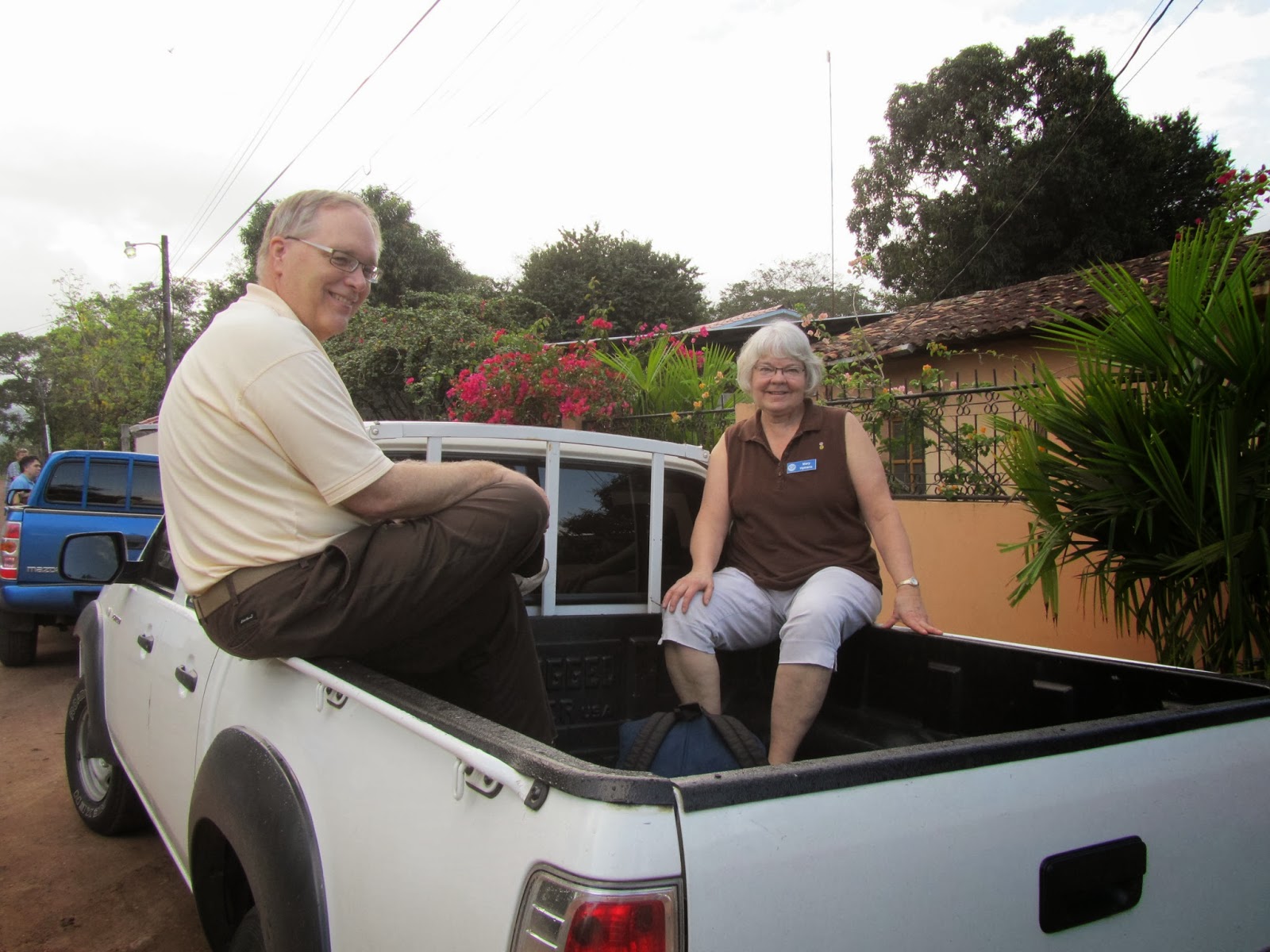
Steve Rith-Najarian, a Bemidji Rotarian and one of our LARA leaders, arranged with Avis to rent five, four-wheel drive, extended cab pick-up trucks from their San Pedro Sula lot upon our arrival on Sunday. and 24 people (our group and RenĂ©) to visit three remote villages.  Without Alejandro and his Land Cruiser on Monday, there was not room for everyone inside the trucks.  Some people needed to ride in the backs of the trucks.  Kade Platta and Yester Voss hopped in back of one truck, and Dan and Mary Hymans climbed in back of another. The ride did not seem that bad at first, but it did not take long before we were off of the paved road and climbing up and down steep hillsides on deeply-rutted, dusty, dirt roads.  After the first stop, most of those in back were ready to switch.

The only one who stayed in back for the entire day was Kade, the high school senior.  He wanted to experience as much of every scene as he possibly could: men carrying loads of firewood on the backs of horses, little 3-wheeled taxis (a driver in front and room for two in back) zipping by us at hair-pin turns, bright yellow flowers on trees without leaves (characteristic of tropical dry-season conditions), young women carrying babies on their hips as youngsters ran ahead, men wearing high rubber boots (as snake protection) and carrying machetes on their way to work in small fields on the steep slopes, skinny cattle foraging on roadside vegetation, chickens dashing from side-to-side across the road, and toothless, elderly women waving “adios” from the doorways of small, brightly-colored one-room houses.  This is Kade’s first time outside of the USA.  All the reading he has done at home does not compare with the power of each new, first-hand encounter.

We crossed one of several Honduran rivers called “Rio Grande.”  This one was the Rio Grande de Otoro.  There was a long narrow bridge across the wide river and a sign warning that no more than one vehicle should be one the bridge at any time.  We needed the four-wheel drive capability in several places along the way.  Our most distant school is only about thirty kilometers (18 miles) southwest of Santa Barbara, but it was a 90 minute journey.

The little village of Teocinte (N 14⁰45.705’, W 088⁰17.242’) sat on a steep hillside.  Part of a group followed a woman up the road to her bright pink house, where she showed the group her pig and chickens.  She lamented the educational challenges that kids face in her village:  forty elementary kids and one teacher.  How can they learn?  Our Santa Barbara Rotarian said that, if we replace the roof, the kids at least will have a functional school house.  Without that much, the kids spend more time dodging the water falling on their desks than they do listening to the teacher.

The largest school we visited has seventy-five students and three teachers in the village of San Jeronimo (N 14⁰59.460’, W 088⁰17.660’), about 15 km northwest of Santa Barbara.  The teachers eagerly embraced Chris Lindsey’s proposal to establish communications between their students and Chris’s students at the charter school in Ashland.  They did not want just one age-group to participate.  All three teachers wanted all of their students involved in the project.

By the time we returned to Santa Barbara and dropped off Chris Keenan to order materials for the first two projects, it was getting late.  Our last potential project is only about 6 km north of Santa Barbara in the village of Los Anices (N 14⁰56.893’, W 088⁰12.591’), near the Santa Barbara Mountain National Forest Reserve.  By the time we arrived, the teachers had taken their bus rides home.  They asked representatives of the local Parents’ Association to meet us and show us the problem with their school house.  Rotarians had replaced the roof at this little two-room school several years ago, but now the wooden trusses are riddled with termite holes.  Unless the trusses are replaced, the roof will soon collapse.

We returned to our base in Santa Barbara without visiting the day care center that the Rotarians want us also to consider.  It is in the city.  If we have sufficient funds and time by the end of the week, we may be able to assist with it.  For now, we needed to debrief about what we had seen and how we wanted to serve.  Each community had high hopes for our help.

Tuesday, February 11, 2014

Kindergarten Construction Progress

Because we were not able to transfer the project funds to our account in Honduras before our Latin America Rotary Aid (LARA) team departed last February, the Santa Barbara Rotarians led the construction work in our absence.  As of November 2013, the concrete block walls and the roof were completed (see the picture).  We hope to have a community celebration for the project when we return to Las Brisas del Pinal next week.

Enthusiasm has grown within our Rotary district for the work we are doing.  Our team this year includes twice as many participants as we have had on the past two trips.  One could ask whether the airlines are the real beneficiaries of our service rather than needy people in Honduras.  What is the real benefit of our traveling to Honduras to provide service?  If our goal were simply to improve health and educational opportunities, we would be more effective simply by sending money to local aid organizations.  Part of the object of Rotary to build an international FELLOWSHIP of people united in service to advance understanding, goodwill, and world peace.  The emphasis is on the importance of PERSONAL acquaintance.  Our service will have greater impact  if we develop on-going relationships within our group, with Santa Barbara Rotarians, and with families in the communities we assist. With a group of 25, it will be a challenge to reach beyond our familiar acquiantances, but I think doing so will enhance the value of the trip for all of us.

Kids' Future Success Grows From Long-Term Partnerships

I am a newcomer to LARA.  This year will be Becky's and my third trip.  Much of our effectiveness during our brief visits is a result of on-going relationships that started more than twenty years ago, largely through the joint efforts of Delores Williams, a Santa Barbara Rotarian, and Ted Will, a Bemidji Rotarian.  Delores was a former Peace Corps volunteer who stayed in Honduras and established an aid center called Casa Rosa, which means "pink house" in Spanish.  She operated out of a pink-colored house that was well known in the community.  For many years, Delores operated as the commanding general for Rotary aid in Santa Barbara.  She passed away before Becky and I joined a LARA team, but her spirit continues in many efforts.  I met Ted Will at the Rotary district conference in Bemidji last spring, and his continuing enthusiasm for the mission might explain why our team is twice as large this year.  He could not be more excited to see new participants on LARA teams as our service continues.

For many of us, our knowledge of Honduras is simply that it is a source of illegal immigrants.  Many Hondurans do depend on income from abroad.  A sixth of Honduras' gross national income is from money sent by family members working largely in North America.  It is harder for us to see how our own personal actions contribute to a cycle of poverty in Honduras.  Often the last thing we consider when we purchase bananas, T-shirts, coffee, or items containing palm oil is the history, policies, or working conditions that brought these items to our store shelves.  One of the most obvious indications of North American influence in Honduras is what we see before we land in San Pedro Sula.  The flat, fertile land surrounding the airport is dominated by banana and oil palm plantations for export crops.  We will not see local food crops until we drive to the steep, rocky hillsides on our way to Santa Barbara.  As we visit with Honduran families, we can ask what conditions promote kids' staying in school and girls' delaying raising families unitl after they develop the knowledge and skills needed for occupations supporting a sustainable lifestyle.  Those are the conditions we hope to support through Latin America Rotary Aid.

Sunday, February 17, 2013

Down In The Valley

On Friday morning our group split into two teams so that we can achieve our goals for the week.  One team headed up the road to the northwest above San Nicholas to the city of Tierra Blanca (N 14⁰57.496’ W088⁰19.437’).  Their job was to replace a leaky roof over one of the classrooms of the elementary school there.  Our local guide Alejandro took Becky and me down from our hotel to the northern outskirts of the City of Santa Barbara.  Here, in the barrio (neighborhood) of Colonia Las Brisas del Pinal (N14⁰56.749’ W088⁰14.093’), is the proposed site of a kindergarten for the community.  Our team’s task was to assess the situation in the community and to evaluate how their needs may have changed subsequent to the closing of the maquiladora (T-shirt factory) last year.

Our hearts sank when we arrived at the elementary school.  The doors were locked, and no children were present.  Alejandro said that, on one Friday each month, the teachers from schools around the area gather in Santa Barbara for a meeting with the district administration.  This must be the teacher meeting day.
When our LARA group drove by this school a year ago, we met briefly with Ulices Bonegos, president of the neighborhood parents association.  In spite of a disability with his eyesight, Ulices is a local community leader who appears to be well known around Santa Barbara.  I asked Alejandro if we might find Ulices and ask him to help us with our task.  Alejandro called to a child who was watching us on the street and asked him to find Ulices.  In a few minutes the child returned with Ulices, a kind hearted, middle-aged man who was carrying his three year-old daughter in one arm.

“I heard that you would be here on February 15,” Ulices said as Becky translated.  “I am very pleased to see you again.”

Becky and I wondered how HE knew we would be coming today because we did not even discuss our visit until after we learned that the project funds had successfully transferred to the bank in Santa Barbara two days ago. It’s clear that Ulices has a very effective, informal network for gathering news.  Maybe he knows the one person who is reading our blog this week.  We told him that we hoped to meet the kindergarten teacher, but we did not realize that today is the teacher meeting day.
Ulices (right), teacher (center) with moms & kids
“It’s no problem,” he said. “Only the elementary teachers are meeting today.  Kindergarten is still in session.  I’ll take you down the street to see the classes and to meet the teacher.”

Clean Water and Sanitation
As we walked down the dirt street to the two rented rooms used for the kindergarten, Ulices pointed to the ditch that runs between the road and the building and to the plastic 4-inch pipe that opens into the ditch next to the entrance to the kindergarten.

“This is the discharge (“agua negro”) from the toilet,” he said.  “It is unsanitary.”
Toilet discharge to ditch by the kindergarten

UNICEF reports that 80 percent of urban dwellers in Honduras and 62 percent of rural residents have access to improved sanitation facilities.  These kindergarteners are clearly in the minority. Less than half of the county’s children under five years-old with diarrhea receive rehydration and continued feeding.  Honduras’ schools provide children a free, mid-morning meal, but this kindergarten has no food preparation area and one toilet for 60 four and five year-olds.  Some neighborhood mothers prepare the children’s food at home and bring it to the rented rooms.

Ulices introduced us to Lily May Oliver Urbina the kindergarten teacher as several neighborhood mothers took the children outside to play.  Lily May has been a teacher in Santa Barbara for twenty-five years.  She said that there are 395 families in this neighborhood, and most of them have children.  Most have experienced great hardship since the factory closed.  Typically, the men of the household leave during the day to find work picking coffee beans, and the women stay home to care for their children.  Lily does her best to make the dark apartment rooms inviting for her students, but there is little ventilation and crowded conditions for so many people.  Because there are too few desks and chairs, she has the older students sit on a board supported by two concrete blocks along one wall.  It was clear to us that the need for classrooms and safe, sanitary facilities was as great as ever.
Kindergarten teacher Lily May (left) with several of her students
and a mother helper.

Our team headed off to join the others at Tierra Blanca.  RenĂ©, president-elect of the Santa Barbara Rotary Club, Chris Keenan, one of the leaders of the Latin American Rotary Aid program, Becky, and I sat around a first grade desk in the elementary school where the group was working.  We went line-by-line through the construction plans and materials needed to construct a two-classroom kindergarten with toilets connected to the city sanitary sewer and with a food preparation area connected to the city water line.  RenĂ© said that he would serve as the local leader for the project and that club members would supply all the unskilled labor as well as the construction engineering needed to complete the project by August of this year.  Our group and our USA/Canada Rotary District will purchase the materials.
Celebrating the Start of Construction

Friday evening the Santa Barbara Rotarians invited Lily May, Ulices, and the new president of the Colonia Brisas del Pinal Parents Association to the Rotary meeting.  The evening was a celebration of the projects we had completed this week, and a commitment to a big construction project about to be launched in support of the community’s next generation of leaders.
The Santa Barbara Roatary Club's celebration to start building a kindergarten for Colonia Las Brisas del Pinal.

Saturday, February 16, 2013

Mountaintop Experiences


Solving Local Problems

On Wednesday and Thursday, February 13‑14, we worked side-by-side with parents and teachers in the mountain villages of Pueblo Nuevo and Las Quebradas to make their local schools more rain resistant and inviting.  In Pueblo Nuevo we replaced a leaky metal roof and painted the one-room school inside and out.  The school district in Las Quebradas had purchased a house adjacent to its existing elementary school for a kindergarten.  The community had knocked out an interior wall of the concrete block house to create a decent area for teaching, but the interior walls were grey unpainted blocks; the old metal roof leaked, and the rafters were rotted.
Installing new rafters for the new roof

What is the real value of replacing a roof and painting a school?  Is helping these villages with these projects creating a cycle of dependency?  Do villagers simply say, “It’s too expensive; let the gringos do it for us” instead of solving their own problems and providing for their own needs?  Dr. Steve Rith‑Najarian, a member of our team who has been coming here for more than twenty years, told us of past experiences where team members came to solve a community’s problems and only created more unintended problems.  He told about a community garbage dump that also served as a treasure trove for little kids who picked through the rat-infested debris to find things that wealthier families had discarded.  The dump was an obvious source of disease.  The group decided that the solution was to build a high fence around the dump and to set hours when the dump would be open and supervised.  The result was that people started leaving their garbage at the gate when the dump was closed. Soon there were two dumps: one inside the fence and one outside.  The poor children still combed through a filthy mess in hopes of finding treasures.

Steve’s point was that “solving” problems for other people is doomed to failure if the community members themselves have not participated in developing the solution.  It takes a lot of time and local leadership development for a community to sift through the mountain of challenges it faces and to set priorities for the needs that most villagers believe will make the greatest difference.  This is where our partnership with the Santa Barbara Rotary Club is critical to the success of the few projects we support each year.  The local Rotarians take much personal time throughout the year meeting with communities spread throughout the department, assessing their needs, and identifying the communities who are committed to implementing changes that our group simply facilitates.  Providing materials and a little extra labor is valuable to a community in extreme poverty, but, more than that, it is an affirmation from outside of long, tireless effort inside the community to make lives of everyone a little better.
 Students paint their school for class tomorrow

In many ways, the men and women we meet as we lift a sheet of steel roofing or paint a wall are models for us.  When we fret about the gridlock we face in dealing with problems in our own communities, we can look to these local leaders who struggle daily to find food for their families or to get healthcare for a sick child.  What they give out of so little for their village makes us almost feel ashamed of the things we complain about in our home towns.

We Are Connected to Each Other

It is hard for us to see the impact of our own decisions at home on the lives of the people in Honduras:  when we buy Central American fruit or coffee in the grocery store, when we buy a T-shirt, or buy a car or truck “made in America.”  It is very easy for us to complain that illegal Honduran immigrants are simply trying to take resources from us in the USA when we do not see the harsh consequences of our own purchasing decisions on them.  When we compare products in a store, we usually limit our choices to quality, price, and brand recognition.  How often do we look at what it took to get that price and to make that product?

By visiting Honduras we see the effects of the economic power we wield on families outside our borders.  Would people in our country tolerate having people in another country do to us what we do to them with our economic and military power?  The OPEC nations give us a small taste of our own medicine when they manipulate the world supply of oil.  Hondurans are in no position to strike back when the US intervenes in their country to protect the control of US fruit companies over the best agricultural land.  Do we ever hear about sending US Marines to Honduras to favor the control of private US interests over the interests of Honduran citizens?  It is news we choose not to hear and history we choose not to learn.

Education Is a Key to Improvement

The villagers in Pueblo Nuevo and Las Quebradas know that they cannot break their cycle of poverty without educated children.  About 75% of Honduran children get through sixth grade. Less than a third of high school age kids go to high school.  Even fewer rural youth go to high school.  It is not simply because a family needs teenagers to contribute to its survival, but also because there are no high schools in rural areas.  A teenager has to leave home and live in a city where there is a high school. Sometimes this happens when a family has relatives in the city who are able to take in the teenager while they attend school.  The teenager may have to combine work and school in order to provide room and board, school uniforms, and school supplies.  One teacher we met planned to leave his job near the City of Santa Barbara so that his daughter could attend collegio (grades 10‑12) in the City of Tegucigalpa.  The parents did not want their teenage daughter to fend for herself in the big city, but they were committed to her educational achievement.
The Pueblo Nuevo teacher with his students

Our work down here is largely aimed at the other end of the educational spectrum: kids entering school.  The kindergarten teachers we met are trying to make their classrooms inviting.  They want children to love learning and to be excited about going to school.  If a five-year-old prefers helping her parents to pick coffee beans to attending school, it’s difficult for them to assure that she will stay in school while they are working on a mountainside far from their village during the day.  It was obvious that the kindergarteners we met adored their teachers.    I do not know how the teachers do it when they have so little materials in their classrooms, but the teachers were the Pied Pipers of their communities.

Striving Toward Sustainability
A worker earns 15 lempira (75 cents) per
3-gallon basket of berries picked.

What are solutions to the economic hardships Hondurans face?  The country created economic incentives for foreign companies to establish maquiladoras here.  Maquiladoras are factories operated by foreign companies.  The maquiladora near Santa Barbara was owned by a South Korean company.  The firm imported cotton cloth and hired Honduran workers (mostly women) to make T-shirts and shipped the finished product for sale in the United States.  Laborers who faced high levels of unemployment in the rural villages were pleased to find employment at the factory, but there were stories of worker abuse.  Workers complained that they were forced to work overtime rather than be allowed to go home to prepare meals for their children.  There were reports of company officials giving women free “vitamin supplements” that actually were morning-after pills that employers used to prevent women workers from becoming pregnant.  The neighborhood Colonia Las Brisas del Pinal is now reeling in economic hardship because the nearby maquiladora closed.  Many of the families that moved here for jobs are now returning to coffee fincas during the daytime to pick coffee.

Brayan, the Santa Barbara Rotarian who worked with us at Pueblo Nuevo, owns three parcels of land nearby totaling about sixty acres where he was growing coffee.  He has a vision for how to achieve sustainable development, and he was eager to show us efforts. He and his wife Miriam are in their late twenties and have a six year-old daughter Sharon. They own a building supply store in Santa Barbara. After we finished repairing the school, Brayan took a group of us for a walk farther up the mountain to his coffee finca.  He showed us a row of small ceiba trees he planted among his coffee plants.

“Everyone here says I’m crazy to put so much effort into planting these trees,” he said as Becky translated.  “It will be twenty years before they are ready for harvest, but, in twenty years, each tree will yield 200 board feet of lumber at $2 per board foot.  Maybe it will be too late to provide for my wife and me, but it will be valuable for our children.”
Separating the beans from the fruit

Brayan said that the finca workers did not realize that he did not want the tall shade trees cut when they planted the coffee plants in this area.  The tradition in the area was to thin the forest before planting the new coffee plants.  Brayan wants to manage his land for both the overstory trees and the understory coffee.  He showed us how the fleshy fruit of the coffee berry is separated from the beans.


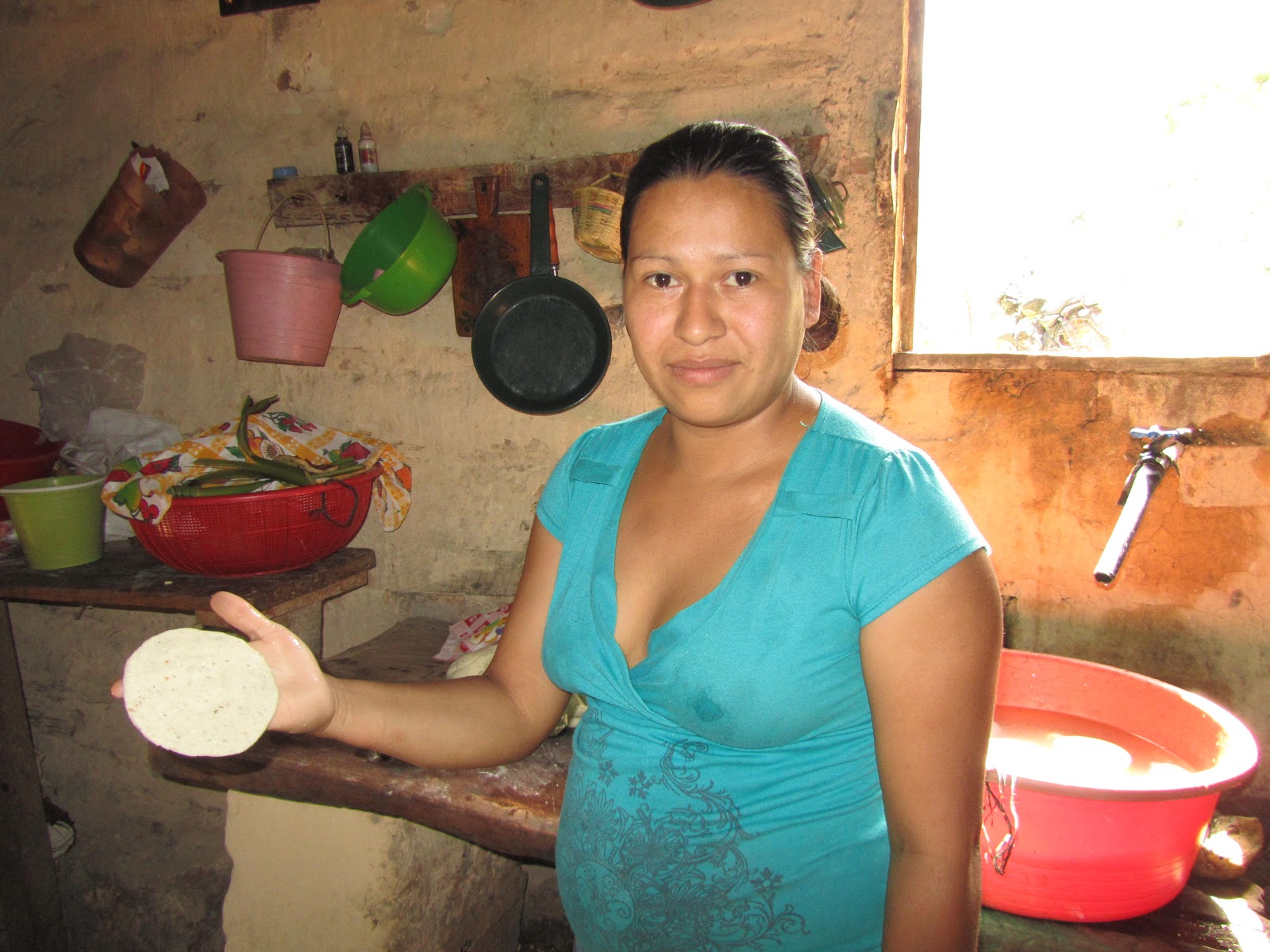
Making corn tortillas from scratch
“Most people here let the fruit of the berries wash down the hillside,” he said.  “I save the organic matter and compost it to enhance the soil.  It is a valuable resource.”


Cooking on a wood burning stove
He went on to explain that he is making changes to the traditional ways coffee is produced and harvested in order to have his operation certified by the Rainforest Alliance.  He said he currently is in the early stage of certification, but he is upgrading living quarters for coffee pickers, improving forest cover over the plants, and reducing his use of industrial chemicals in order to be fully certified.  He expects certification to improve the quality of the coffee he produces, to increase the price he can get for his product, and to increase the income of the families who work on the finca.

Brayan took us to the century-old building where his coffee pickers live during the harvest and to the kitchen where their meals are prepared.  A woman in the kitchen showed how she makes sixty tortillas per meal twice a day from dried kernels of corn on a wood-fired stove.  The old building had rows of triple decker bunk beds for twenty-four workers.  He said that, even though this is a long-time tradition in this area, he will be building smaller, more family-friendly quarters with better sanitation for the workers.


Workers' bunk beds
At the dinner meeting of the Santa Barbara Rotarians last night, Brayan and Miriam gave each of us two pounds of coffee from their finca as a sign of thanks for the help we provided during our stay.  Each bag had a label expressing thanks for the partnership we maintain.  I think coffee also expresses a hope for the future.  When an agricultural product is produced by local people on relatively small plots in ways that maintain or enhance the productivity of the land, there is hope for the future of these little villages on the mountaintop.